Only in hindsight can one see the different events and factors that resulted in one finding his life’s work. That is certainly the case in my own story, but that is a story for another day. Instead this opst addresses the more practical of how I became a counselor.
You would think it a straightforward process, and maybe it is for those who have been through it, but for those about to set forth, it is generally not a clear path to the end.
Many people decide to become counselors because they want to help people. This is largely a mistake. There is no metric to “help people” except one’s own emotional satisfaction. Nearly 90% of counselors make annual salaries in the $35k-$40k range because they became counselors because of how it made them feel, not because it was a good fit.
Before even applying to grad school, I called a half dozen counselors and asked for an hour of their time so I could learn more about the actual work and culture of the counseling profession. Half of those were generous enough to oblige. The work itself and the “daily grind” seemed tolerable enough, even somewhat interesting.
The best advice I received in that period was, “go to grad school to get your piece of paper that says you fulfilled the requirements. The real learning comes after grad school when you pick a supervisor for your internship. Make sure you pick a good one, not just one that will rubber stamp your timesheets.”
The internship of which I speak is the 3,000 hours oc “supervised” counseling one must complete after graduation. “Supervised” counseling generally means that an intern, or “associate” as they’re now often called, meets with the intern’s supervisor once a week to discuss the various cases, approaches for helping clients, and the supervisor watches out for whether the intern has any major issues that are or will become ethically problematic in this line of work.
I went to graduate school. During my time in graduate school, the state educational program required 700 practicum hours to get our feet wet and see if we even liked counseling. It is the student’s responsibility to find placement. I’d read some articles about counseling offices in the Emergency Department of hospitals and thought it an exciting read, so that’s where I volunteered for my practicum hours.
With 700 practicum hours and 2.5 years of graduate school complete, I walked across the stage having earned a Masters of Education in Clinical Mental Health Counseling. The degrees of counseling vary in name or description across institutions, but they’re the same thing.
During practicum, I began attending the local events for counselors. Yes, they’ll even let non-counselors into those events, often for free or a small admission fee. I kept a list of the counselors who were leaders, not followers, their specialities, and whether or not I thought I could learn something from them. I narrowed it down and made an approach, introducing myself to one of the speakers at a local event. He was very personable, made complex concepts simple to understand. I knew I could learn something from him, and he didn’t disappoint, and he was my supervisor for the rest of my 3,000 hours.
(A note about counselors: Many of them are very timid and risk averse, are followers. Many who aren’t are not actually very good at leading, teaching, or listening unless they’re getting paid for it, oddly enough.)
During supervision, an intern or associate generally has to bird-dog his or her own clients, a very painstaking process when starting from scratch. Supervisors generally have enough of a client flow to keep them busy, but not keep their interns busy. Sometimes, the supervisor will refer some clients to the intern, but don’t expect it. If interning at a mental health clinic, the clinic may provide an abundance of clients, but the pay will be minimal, and it will hurt financially and emotionally. You may see clients at the community mental health clinic who also have the latest iPhone, drive an Escalade, and carry Coach or Louis Vuitton handbags, and many counselors become resentful at the sight.
Placement Matters
The placement you choose determines the caliber of clients. If an intern or associate chooses a community health clinic in which to fulfill the 3,000 hours, they can expect low-income, low IQ, low discipline, with a weak sense of personal accountability, most of whom will no show a majority of their sessions. The pay is minimal, maybe even volunteer. Few professionals want to work there because of the poor effort-to-success ratio.
The local drug and alcohol center is a little better in that these clients generally have more motivation to go and get help. They’re in a real place of pain and want to be free in some sense of the word. There are many failures though too and many more clients with personality disorders that have chaotic interior lives that can be hard to know which version of them will show up at the meeting today.
A private practice setting pays the best, has a higher percentage of clients who want help and have enough skills and intelligence to make some headway under the care of a skilled counselor. There are fewer failures and fewer “no-shows”. Once a counselor is on his feet and has a steady client base, the counselor no longer feels the daily financial pinch, is better able to help the clients. A higher per-session rate ensures higher quality clients, higher success rate. (The law of diminishing returns still applies.). I chose the private practice approach and haven’t regretted it for a second.
If you make it all the way through grad school and into supervision, don’t think of your supervisor as the only person you need to learn from. Continue seeking education from many sources. Clients with a certain type of identity disorder began flocking to my office in rapid succession, so I sought out the world’s expert in that identity disorder, and many others. Turns out his office was only 90mi away from me. I had a sweet deal with him. He had so many clients and few associates trained in that discipline that he flooded me with clients, trained me himself, and set my per-session rate above even my own supervisor’s rate for his clients, all while under the guidance of my supervisor. I had two teachers, both teaching me different skill sets all of which was instrumental in my work.
Mindset
Counseling has always been a business to me. Many people think of business as something designed to take money from a customer. I was taught by old school businessmen, “keep your customers happy” and “every complaint is an opportunity”.
Many people ask if my work is a ministry. “No, it’s a business” I always answer. In a ministry, there is no metric for success. Tens of thousands of ministers are employed throughout the country, and none of them can show you a metric for success that means anything. It’s all ambiguous. The process is the focus. In a business, the end goal is the focus.
- Did I provide the end result that my client desired?
- Did I do so in a timely and effective manner?
- Did I make th ebest use of the client’s time, money, and effort?
- Is there anything else I can do better to help the client reach that end goal?
Many counselors don’t ask these questions. They’re stuck in ministry mindset of not defining the goals, not having a clear and effective path to accomplish that goal, mostly because 90% of the counseling approaches don’t work long-term.
A counselor should never “take” from his or her client, engaging in chit-chat on the client’s dime.
A counselor should never indulge in the engaging storyline of the client’s recent events or relationship drama to satisfy the counselor’s curiosity.
Method
I said earlier that 90% of counseling approaches don’t work. It’s true. The dirty little secret about therapy is that most counselors nver heal anyone. They string along their clients hoping that one day something will click, but the counselors are just throwing darts at the board hoping they hit a bullseye by some random chance.
What do I recommend?
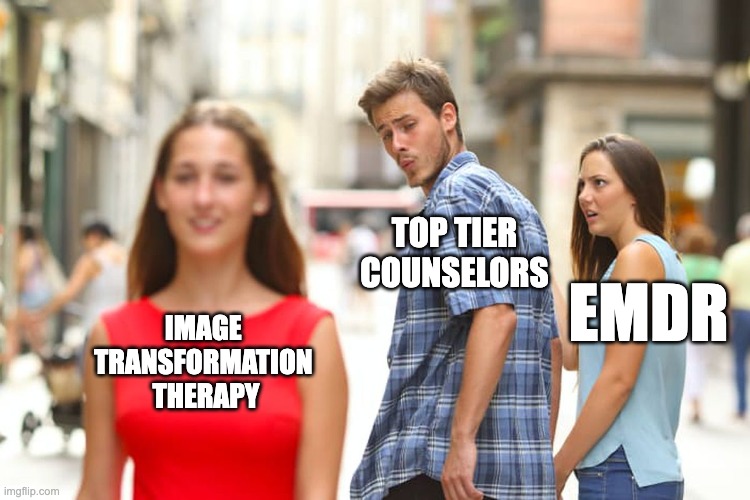
Image Transformation Therapy, also called ImTT (“eye-emm-tee-tee”) is an approach developed by psychologist Dr. Robert Miller as a gentler alternative to EMDR and “the lights, or tapping, or wand or whatever they call that process” my clients say. EMDR is considered the industry standard for therapeutic approaches, but all (not an exagerration) of my clients who have tried it in the past with other counselors said it was emotionally exhausting for days after each session. And each of those clients who had done EMDR eventually headed back to therapy a few years later, not with the same EMDR specialist, but with someone else (me).
As my mentor always said, “the proof of the pudding is in the tasting” and a lot of clients tasted EMDR and though they received “some relief”, were left unsatisfied. That tells you something.
So we do Image Transformation Therapy. Where EMDR requires the client to go into deep recall of painful memories of past events, ImTT keeps everything at surface level. The mind already knows how intense those emotions are below the surface, no need to bring them up and feel them deeply in order to have the mind release its hold on feelings of pain and fear. The best part is ImTT is gentle. Clients feel a little mentally tired from the exercise because their brains are burning calories, but they feel emotional relief when they leave the office, often in tears of joy at the amount of relief they experienced during the session.
As i said before, the proof of the pudding is in the tasting, and clients know within 2-3 sessions if they like this gentler and more effective approach.
If you are interested in learning more about if this approach might work for you, visit The Freedom Clinic to sign up for a free, 15-minute video consultation.


Leave a comment